
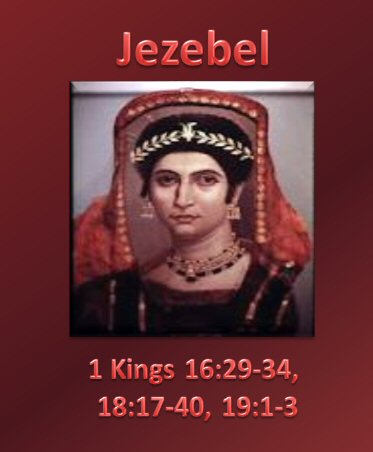
Have you ever known any bad girls? I want us to take a look at the story of probably one of the baddest girls ever recorded in the Bible. That is the story of Jezebel. Now, if you’ve ever been a bad girl, of maybe even leaned toward being a bad girl, some one at some time may have referred to you as a Jezebel. I hope not, but some have been. Her name has come to represent the worst of the bad girls.
She was a princess from the rich coastal city of Sidon in Phoenicia, where her father was king. He had taken over the throne, and was a force to be reckoned with. Strong men often have strong, ambitious daughters, and Jezebel proved to be just that. Let’s just say the apple didn’t fall far from the tree.
But for more than two thousand years, Jezebel has been burdened with the reputation as the bad girl of the Bible, the wickedest of women. Jezebel’s name has been used for thousands of years to describe cunning, ruthless and despicable women. Some believe she typifies evil. Others believe that Jezebel was one of the first to stand up for the rights of women. Either way she’s been called a murderer, prostitute and enemy of God, a very bad girl.
Throughout the centuries, Jezebel has been attacked as a whore, and her name has been used to describe a woman of promiscuous behavior. But there is nothing in Jezebel’s story to suggest that she was ever unfaithful to Ahab. In fact, she seems to have been fiercely loyal to him and her sons, even in adversity. II Kings (2K. 9:22) seems to refer to idolatry rather than immorality. This writer believes she was more of a ‘spiritual’ prostitute than a carnal one.
Jezebel was powerful, a woman and a foreigner. These qualities made her a target for the prophets of God. In the long run, she backed the wrong gods. She ruled with forceful power, which went against the Israelite ideal of kingship. But she was a woman of tremendous ability and intelligence, strong-willed, courageous and loyal and for that reason she was hated.
Jezebel was not a heroic fighter like Deborah, a devoted sister like Miriam or a cherished wife like Ruth. She represents a view of womanhood that is the opposite of the one eulogized in characters such as Ruth the Moabite, who was also a foreigner. Ruth surrendered her identity and submerged herself in Israelite ways; she adopted the religious and social norms of the Israelites and was universally praised for her conversion to God. Jezebel steadfastly remains true to her own beliefs. We have to admire her loyalty to her gods and her courage to stand up for what she believes. I can only wish more Christians showed that kind of loyalty to their God and the courage to stand up for what they believed.
Why do Christians marry unbelievers? I don’t know but in Ahab’s situation, I doubt it was for love, although it might have been physical (sexual) attraction in part. The story of Jezebel, a princess married to Ahab, king of the northern kingdom of Israel, is set in the turbulent period of the divided kingdoms, when various dynasties struggled for political power in Israel and Judah. The Bible Knowledge commentary informs us that one of the great “accomplishments” of King Omri’s life was his military alliance with the Phoenicians (Sidonians) which was sealed by the marriage of Ahab to Jezebel (daughter of the Sidonian King). This marriage brought with it increased earthly power and authority. The people of Israel wavered between God and Baal, and there was mutual hatred between the priests of God and Baal. Each side was more than happy to murder their opponents and we see that still going on today! Just pick up a newspaper or tune in to your local news station.
This heartless woman with a bloody history failed to live up to the name she bore, for Jezebel means, “chaste, free from carnal connection”; but by nature she was the most immoral of all women. The Bible Knowledge commentary tells us her name means either “dunghill,” or “without cohabitation, un-husbanded”. Her name in Hebrew means “where is the prince” the ‘prince’ being the fertility god Baal. When Baal was in the underworld or Land of the Dead, it was winter. Baal’s followers would then chant ‘Where is the prince?’ as a prayer to encourage the onset of spring and the return of vegetation. Whatever her name means, Jezebel was determinedly loyal to Baal, and went to her death wearing the ritual make-up and headdress of a priestess of Baal. In his two-volume Guide to the Bible (1967 and 1969), Isaac Asimov describes Jezebel’s last act: dressing in all her finery, make-up and jewelry, as deliberately symbolic, indicating her dignity, royal status and determination to stand her ground to go out of this life as a queen.
She was a woman concerned with luxury and sensual pleasures, with all the cheap and gaudy finery of a ‘loose’ woman. In some interpretations and some religions, her dressing in finery and putting on makeup before her death led to the association of the use of cosmetics with “painted women” or prostitutes (harlots). The name Jezebel came to be associated with false prophets, and further associated by the early 20th century with fallen or abandoned women. In Christian lore, a comparison to Jezebel suggested that a person was a pagan or an apostate masquerading as a servant of God, a ‘pretend’ Christian. By manipulation and/or seduction, she misled the saints of God into sins of idolatry and sexual immorality. In particular, Jezebel has come to be associated with promiscuity. In modern usage, the name of Jezebel is sometimes used as a synonym for sexually promiscuous and/or controlling women.
This was the “first time that a king of Israel had joined himself by marriage with a heathen princess; and the alliance was in this case of a peculiarly disastrous kind. Jezebel has stamped her name on history as the representative of all that is designing, crafty, malicious, revengeful, and cruel. She is the first great instigator of persecution against the saints of God. Guided by no principle, restrained by no fear of either God or man, passionate in her attachment to her heathen worship, she spared no pains to maintain idolatry around her in all its splendor. In other words, Jezebel slaughtered the representatives of the true God. Systematically, one at a time, in various areas. Four hundred and fifty prophets ministered under her care to Baal, besides four hundred prophets of the groves. Grove is simply a satellite place of worship, we might say. So not only was there a temple of Baal now in Samaria, there were many satellite areas that were set up as well. The idolatry, too, was of the most depraved and sensual kind. Her conduct was in many respects very disastrous to the kingdom both of Israel and Judah. There was open conflict between the followers of God and Baal. Jezebel supported the agricultural gods Baal and Anat. Elijah supported his God. Jezebel’s husband Ahab tried to play peace maker and steer a middle course, encouraging tolerance between the two belief systems.
But the point is: Jezebel is mentioned as a murderer. Often times evil will pursue good to try to eliminate it. Now why could that possibly be the case? Well, Satan doesn’t like good. The more good there is around, the more truth there is around; the more exposed the lies are. So having a righteous individual around evil people, is like that righteous person shining a bright flashlight in some ones eyes in the pitch dark. It is very irritating. Jezebel could not stand righteous competition because that righteous competition would show just how false her system was. So Satan inspired an elimination of the people of God, the prophets of the Lord, in this case.
Jezebel was given power and she was corrupt and as a result that power continued to corrupt her even more and the results of that corruption were spilled out in human blood in many other people.
According to the account in the Hebrew Bible, Ahab and Jezebel supported the worship of the deities Baal and Asherah, erecting shrines to them in Samaria, which was “evil in the sight of the Lord”. The Bible states that there was never anyone like Ahab, who sold himself to evil, encouraged by his wife. Ahab was like a puppet in the hands of his overbearing wife. Because he was spineless and weak, Jezebel found it easy to achieve her murderous designs. It was Jezebel who became the feared commander in Israel and not the cowardly husband she could wrap around her little conniving finger. It may be that Ahab was more luxury-loving and sensual than cruel, but under the complete domination of a ruthless woman he was forced to act against his finer feelings. His guilt in this hideous drama lies chiefly in his using his personal power as a means to Jezebel’s wicked ends. For without Ahab’s authority, Jezebel would have been a snake without fangs. In this marriage, Ahab was the weaker vessel with a wife who mocked his conscientious scruples and bound him in all wickedness as with strong chains. You could say Jezebel wore the pants in that family, a role reversal common in our day.
It was this heathen woman who married Ahab, king of Northern Israel, and who in so doing was guilty of a rash and ungodly act which resulted in evil consequences. As a Jew, Ahab sinned against his Hebrew faith in taking as his wife the daughter of a man whose very name, Ethbaal, meant, “A Man of Baal.” Any man, able to resist the wiles of a sensual but wicked woman possesses true heroism. Joseph succeeded against the lovely yet lustful wife of Potiphar, but Caesar and Antony after conquering almost the whole world, were conquered by the fair but foul Cleopatra. Samson gave away the secret of his power to the beautiful and alluring Delilah.
Jezebel was no ordinary woman. Such was her demeanor that she attracted immediate attention. Though by no means an attractive person, she was invested by her extraordinary force of character and her horrible fate with a tragic and a false greatness which belongs to no other woman of the Bible. While the Bible does not analyze or even portray her character, but simply sets forth the events in which she bore so prominent a part, yet as we read between the lines we cannot fail to see her as a woman of extraordinary force of intellect and will. The sacred narrative does not record that she possessed any of the finer, nobler feminine qualities. She knew nothing of the restraint of higher principles. Savage and relentless, this proud and strong willed woman carried out her foul schemes. A gifted woman, she prostituted all her gifts for the furtherance of evil, and her misdirected talents became a curse. Persuasive, her influence was wrongly directed. More determined above other women, she used her strength of character to destroy a king and her own children, as well as pollute the life of a nation.
Baal had no more dedicated devotee than Jezebel. None could match her zeal for the worship of Ashtaroth the famous goddess of the Zidonians, as zealous and liberal maintenance of hundreds of idolatrous priests clearly proves. Not content with establishing the idol worship of her own country in her husband’s court, she sought to convert Israel to Baal worship. Two heathen sanctuaries were built, one at Samaria with its 450 priests, and the other at Jezreel with its 400 priests. In a most relentless fashion Jezebel tried to drive out the true prophets of God from the land, and thus became the first religious female persecutor in history. From her idolatrous father, a high priest of Ashtaroth, she inherited her fanatical religious enthusiasm which inspired her to exterminate the worship of the true and living God, and almost succeeded in the attempt.
Jezebel and all the members of her family were killed during a palace coup led by Jehu. She was thrown down from a palace balcony and eaten by dogs.
When Jehu came to Jezreel, Jezebel heard of it. She knew she was going to die so she painted her eyes, and adorned her head, and looked out of the window. As Jehu entered the gate, she said “Is it peace, Zimri, murderer of your master?” He looked up to the window and said “Who is on my side? Who?” Two or three eunuchs looked out at him. He said “Throw her down.” So they threw her down. Some of her blood spattered on the wall and on the horses, which trampled on her. Then Jehu went in and ate and drank. He said “See to that cursed woman and bury her, for she is a king’s daughter.” But when they came to bury her, they found no more of her than the skull and the feet and palms of her hands.’ ” Read 2 Kings 9:21-37.
Jezebel died as a queen should die: dressed royally as a queen and a priestess of Baal, magnificent, with courage and defiant, hurling insults at her murderers to the last moment of her life.
Frankie Laine recorded “Jezebel” (1951), written by Wayne Shanklin, which became a hit song. The song begins:
If ever the Devil was born without a pair of horns
It was you, Jezebel, it was you
If ever an angel fell
Jezebel, it was you, Jezebel, it was you!
In His love,
Elizabeth


 Ponderings Of A Seeking Heart
Very informative Ms.Elizabeth, I have known several Jezebels’ in my life, and hope to never know another..On the other hand, I have also known men that are attracted to that spirit in women.
And I do consider it a spirit..Not because they don’t worship my God, simply because I don’t like hardheaded foul women…Wait! Wait!…come to think of it I don’t like men like that either..LOL!
God Bless You
PoppaK
LikeLike
Thak you Poppa and God bless you always! ❤
Come to think about it, I don't like that spirit in anyone either. ROFLOL
LikeLike